

On this first new moon of spring 2026, my imagination overflows with the images Artemis II delivered. Ideas of human space travel have been circulating since the ancients turned their eyes to the heavens. Contemporary myths zip space warriors from planet to planet, disappearing into hyperspace to a galaxy far, far away. Our modern astronaut stories are so seamless that I was surprised to realize that Artemis was the first crewed trip to the moon since Apollo’s journey in 1972. Those first fuzzy images have been replaced by crystal clear, cinematographic scenes (including a jar of Nutella making a floating cameo.) The crew’s willingness to share themselves with us over ten days generated enthusiasm and goodwill that met the magnitude of the moment. On April 10, Danny and I held our breath as we witnessed the crew’s return. Sitting in my car, huddled over his phone, we watched the Orion craft hit the atmosphere at 25,000 mph and for 8.5 tense minutes we waited teary-eyed for the astronauts to splash down safely.
The return is the final stage of the hero’s journey and we gather to hear the story. In this case, our royal blue jump-suited astronauts gathered onstage 24-hours later to speak at a press conference. Each of these extraordinary humans made brief and poignant observations.
Commander Reid Wiseman recognized that no one understands what families go through, the sacrifices they make, he says, “Before you launch it feels like it is the greatest dream on earth, and when you are out there, you just want to get back to your family and friends. It’s a special thing to be a human and to be on the planet earth.”
Pilot Victor Glover expressed gratitude for the experience he had and the team with whom he shared it. This gratitude he felt was bigger than one body and it overflowed into love.
Mission Specialist Christina Koch defined crew, “A group that is in it all the time no matter what, that is stroking together every minute with the same purpose, that is willing to sacrifice silently for each other, that gives grace, that holds accountable. A crew has the same cares and the same needs, and a crew is inescapably, beautifully, dutifully linked. And so, when we saw tiny earth, people asked our crew what impressions we had. Honestly, what struck me was not tiny earth, but it was all the blackness around it. Earth was just this lifeboat hanging undisturbedly in the universe.” (She put her head down and took a long, emotion-filled pause.) “So, I may have not learned everything this journey has yet to teach me — I know I haven’t — but I do know that Planet Earth, you. Are. A. Crew.”
During Mission Specialist Jeremy Hansen’s summary, he mentioned the science — it was there and valuable — but what seemed particularly noteworthy to all of them were three human experiences: gratitude, joy (the “joy train"), and love. He asked his crew to join him. The four stood arms locked over shoulders, forming a bright blue field. “What you saw was a group of people who loved contributing, having meaningful contribution and extracting joy out of that. And what we have been hearing is that was something special for you to witness, and the reason I had them form up here with me, is because I would suggest to you that when you look up here, you are not looking at us, we are mirror reflecting you. If you like what you see, look a little deeper. This is you.”
I have described this homecoming to three of our writing groups. And each time, I have looked at a sea of blue prison uniforms as I describe Reid Wiseman wanting to get home, heads nod in understanding. Most of the time, being in prison feels as far away as a trip to the moon.
In addition to being far home, folks in prison rely on a crew — to keep heads clear, maintain sobriety, navigate loneliness, and dark days. They have caused harm, seen unspeakable violence, have spent most of their lives far outside safe spaces. They have climbed in and out of remarkable danger and carry those wounds. They smiled when I mention the joy train, because even in prison you can find the joy. It comes in all forms, sometimes as simple as the sun on one’s face in the prison yard. And in prison, yes in even in prison, there exists extraordinary acts of love, service, and purpose … right alongside every day, laughing with the friends you love.
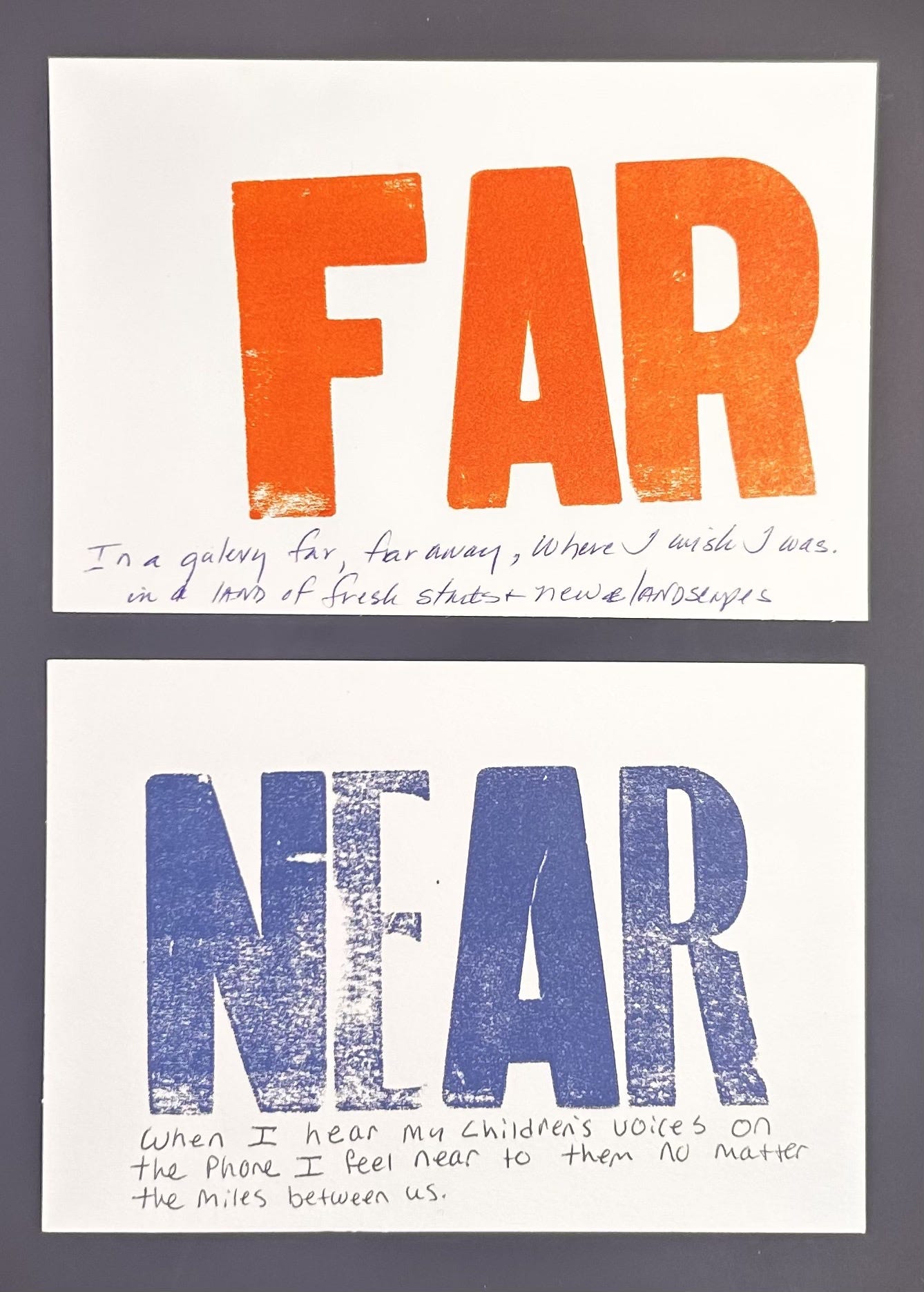
The writing group at Eastern Oregon Correctional Institution has broadened the circle of our youth outreach project. The men have been working on pieces about how to parent from long distance, including ways they attempt to make that distance draw near. A devoted dad who works hard to maintain his connection to his children, Luis Rodriguez wrote and recorded Miles Apart. The journalists from Eastern Oregon Correctional Institution’s newsletter The Echo interviewed folks during a PonyXpress event and they were asked to describe what made them feel near or far from their family. we have included some of their responses with Luis’s song.
We’re miles apart…
But when I close my eyes, I can feel you… in my arms.
We’re miles apart
But we share a laugh on the phone we’re… close at heart.
— Miles Apart, Luis Rodriguez
Like astronauts, prisoners experience “tiny earth” from a unique vantage point. Human experiences that superficially seem far apart share close connection points of gratitude, joy, and love. Indeed, Jeremy Hansen, we mirror one another. | TDS
LISTEN
EOCI contributers: Ian Lohrman, Chris Ainsworth, Phillip Luna, Luis Rodriguez, and Kurtis Thompson.
Beautiful and so poignant. Love the printed cards and respective comments 💫💜